Global capitalism, Politics, Society, Travel, colonialism, slavery

02 Aug 2010

The Bahamas – sun, sea, sand & slavery

Today is Emancipation Day, not just in the Bahamas, but all across the former British empire. 176 years ago – in 1834 – my nation, Britain, finally abolished slavery. The Bahamas as a nation, however, is only five years older than me… not until 1973 did the Bahamas became independent from Britain – they celebrated the birthday the weekend I arrived.

This island and its family islands of the Commonwealth of the Bahamas share alot of history in common with the Caribbean as whole; the region was home to several million peaceful native Americans, who were almost completely wiped out by the Spanish and then by the English, through slavery, outright murder and disease. Both countries then imported black slaves stolen from Africa, depopulating some areas by between 60 and 90 per cent. For a time in the 17th century the Bahamas was administered from the Carolinas, and from 1718 directly by the British. These are young cultures, with their populations all from somewhere else – most of them moved here by force.

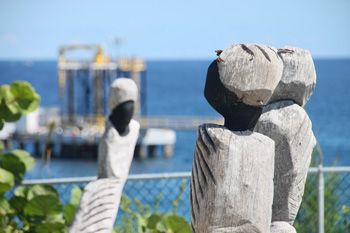
Sacred Space by Antonious RobertsOne of the most moving things I’ve experienced on the island so far is an artwork “Sacred Space” by Bahamian artist Antonious Roberts; figures of slave women carved out of casuarina trees, still rooted in the ground; they look out over the ocean, towards Africa. Even more moving, a few yards away are the “Pirate Steps”, more accurately called the Slave Steps because up them from about 1785 onwards were marched thousands of African slaves who were brought here to work for the ruling white people on the island. At the bottom of the steps I found a young white American couple from the South, larking about and taking photos of eachother on the rocks, unaware or uncaring of how their predecessors had driven thousands of other human beings across those rocks like cattle. A few yards further along, the same harbour that berthed the slave ships now accommodates Esso oil and gas tankers.

So most people in these countries like the Bahamas have been the working class, working for someone else’s benefit, for not just decades but centuries. Since I’ve been here I’ve met black Bahamians who are film-makers, business people, university staff and professors, poets and authors. People who are well-travelled, highly intelligent, thoughtful, conscientious and considerate. But black society in Continue Reading »

Social Bookmark this: These icons link to social bookmarking sites where readers can share and discover new web pages.
  • Digg
  • del.icio.us
  • Facebook
  • Mixx
  • Google
  • Furl
  • kick.ie
  • Live
  • Ma.gnolia
  • NewsVine
  • Reddit
  • StumbleUpon
  • Technorati
  • TwitThis
  • YahooMyWeb
Email This Post Email This Post

America, Politics, Society, The Right

13 Jul 2010

The Day I Met Some Conservatives

I am completely aware there are lots of conservatives in America. I’ve been bracing myself for meeting them, as I made my way out West. I just didn’t expect to meet them in the form of young people in their early twenties, certainly not college students, and certainly not on public transport in Obama’s home town, the Democratic lock down that is Chicago.

So I accepted a generous invitation of visiting cultural sights such as architect Frank Lloyd Wright’s Chicago home & studio with gratitude, not realising that my hosts for the day (which involved a lot of being trapped in their car) were pretty much Tea Partiers, only young, stylish and attractive. Which, let’s face it, is not the image that normally comes to mind.

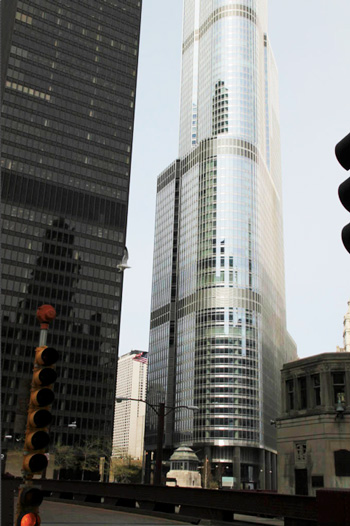
The huge new Trump Tower in Chicago's downtown

The huge new Trump Tower in Chicago's downtown

In fact the boyfriend and girlfriend couple were nothing but generous, kind and thoughtful to me. I’m just pretty sure that wouldn’t have been the case if I’d been Hispanic. Which was funny, because the girl was half Hispanic – her dad from Peru – and she speaks decent Spanish. But Hispanics, blacks and women drivers came up in the first five minutes (women drivers were actually what started it all off….) and from then on in I knew there’d be trouble (at least if I didn’t keep my mouth shut).
I could have ignored the quip about women drivers – we used to humour him when Grandad started – but that led quickly to a conversation, all the while trapped in the car of course, about how Obama is not culturally black. This is an argument I have realised is fairly valid: Obama is completely atypical of black people in the US, and, dare one mention, is of course half white. Furthermore his family was not an enslaved family, unlike the history of most black families in America. And, unlike almost all black people, he has had a white person’s education at the very best schools and colleges that America has to offer, and money has to buy. Of course, this is a controversial if not offensive argument amongst most progressive Democrats, and understandably so. But at this stage I was still not sure what side of the fence they were falling down on, and I was finding some common ground. I started to become sceptical however after being told that blacks have had 50 years since the Jim Crow laws to pull themselves up by their bootstraps, that this went for Hispanics too, and that Obama was socialising all the banks because he is on a mission to make everything owned by the government.

I was still naive enough at this point to answer frankly the question they put to me about how Obama is perceived in Europe. I gave an answer which I am pretty sure 85% of Europeans would be happy with, that Europeans in general and the British in particular still perceive Obama to be a blessed relief after that “moron” George W Bush.

The silence in the car around me was palpable.
I backtracked, clarifying that W was probably “not the sharpest tool in the box”, and I mumbled something about him being perceived by many in my country to be a puppet of other forces (of which, I did not elaborate). That’s about as two-way as the conversation got the entire day, which we were about ten minutes into. After that, I learned to listen with curiosity, fascination, and, it has to be said, a little each of respect and horror.

The conversation took the form of “you see the thing is Matt, there’s something happening in this country right now that you need to know about, something terrible”. Continue Reading »

Social Bookmark this: These icons link to social bookmarking sites where readers can share and discover new web pages.
  • Digg
  • del.icio.us
  • Facebook
  • Mixx
  • Google
  • Furl
  • kick.ie
  • Live
  • Ma.gnolia
  • NewsVine
  • Reddit
  • StumbleUpon
  • Technorati
  • TwitThis
  • YahooMyWeb
Email This Post Email This Post

America, Fuel, Politics

30 Jun 2010

Oil disaster in the Gulf – a failure of government

I’ve been in New Orleans and Florida the last few weeks and there is genuine anger that the oil disaster in the gulf is still going on. The government, and the corporations responsible for building, operating and mitigating the disastrous impact of the drilling operation have all been fairly useless in doing anything real about it. And everybody knows it.

My friends Stella and Mitch in New Orleans were kind enough to let me video them briefly about their perspective. They give heartfelt testimony to just how important this stuff is, and how hugely it is affecting the tourism, fishing and oil industries in Louisiana and further afield that are the mainstay of most people’s livelihoods.

Needless to say, BP has come in for an awful lot of stick. Signs attached to New Orleans lamp-posts insult BP. I saw a woman dancing with her partner at a Zydeco music festival sporting an “FU BP” poster pinned to her back. But the shocking thing to me is not that a multinational corporation should externalise its costs and risks, and screw people and the environment in the process. It has been the almost utter inability of the US government to do anything effective about it.

Yet many people – on the left and right of the political spectrum – have fallen into what I see as a trap of blaming BP, as if BP is a “bad apple” and all other oil corporations are fine, a piece of “framing” that hides the larger systematic issues and abuses. Certainly the right-wing old fogies here in Florida are clinging to this narrative: “BP is some corrupt British corporation, coming over here and colonising American resources. Corporations in general (including and especially American corporations) are OK; it is this errant and colonialist, elitist, distant British corporation – operated by some posh English dude – that is purely at fault”. While BP are obviously guilty of massive and criminal negligence, to understand the situation blame must be levelled at the other corporations involved, at the federal regulator (which Obama has now taken to task because it was hand-in-glove with the oil industry), and at the federal government itself. But moreover, America’s laws and political culture are exacerbating the situation: the government is hamstrung (partly legally) from effectively responding to the crisis because it is not an act of God but the actions of a corporation, for which they are legally responsible. The federal government has not been able to (and/or willing to) step in and mitigate the situation in the way they morally should have. Republicans, for all their rhetoric, have only made the situation worse and prolonged the crisis.

Last week’s decision by a federal judge to overturn the Obama-administration imposed moratorium on drilling just shows how uncaring the Republicans are about the real issues involved, and how much they have bought into (and are propagating) the shallow “bad apple” frame, without looking at the obvious danger of this happening again. Judge Martin Feldman’s decision also, of course, shows up the blatant and chilling partisanship of the US judicial system.

As it happens, and as my friend Mitch from New Orleans mentions in his video, the moratorium is an imperfect solution that itself is damaging ordinary people’s livelihoods. But when a federal judge and the corporations responsible for criminal negligence are singing from the same hymn sheet, I get the chills.

So for me the issue is far FAR bigger than “is BP a bad apple?”. The frame needs to be: oil exploitation is inherently suicidal, all these corporations are out to screw over people and the environment and animals for a quick profit, American political culture is actually set up to HELP them do that and not to prevent or mitigate the likely disastrous results, and there needs to be a wholesale reform of not only energy policy but a culture and legal structure of corporate welfare that goes to the heart of what America is today.

Social Bookmark this: These icons link to social bookmarking sites where readers can share and discover new web pages.
  • Digg
  • del.icio.us
  • Facebook
  • Mixx
  • Google
  • Furl
  • kick.ie
  • Live
  • Ma.gnolia
  • NewsVine
  • Reddit
  • StumbleUpon
  • Technorati
  • TwitThis
  • YahooMyWeb
Email This Post Email This Post

America, Green Party, Society, Travel

15 Apr 2010

Canada… versus the USA

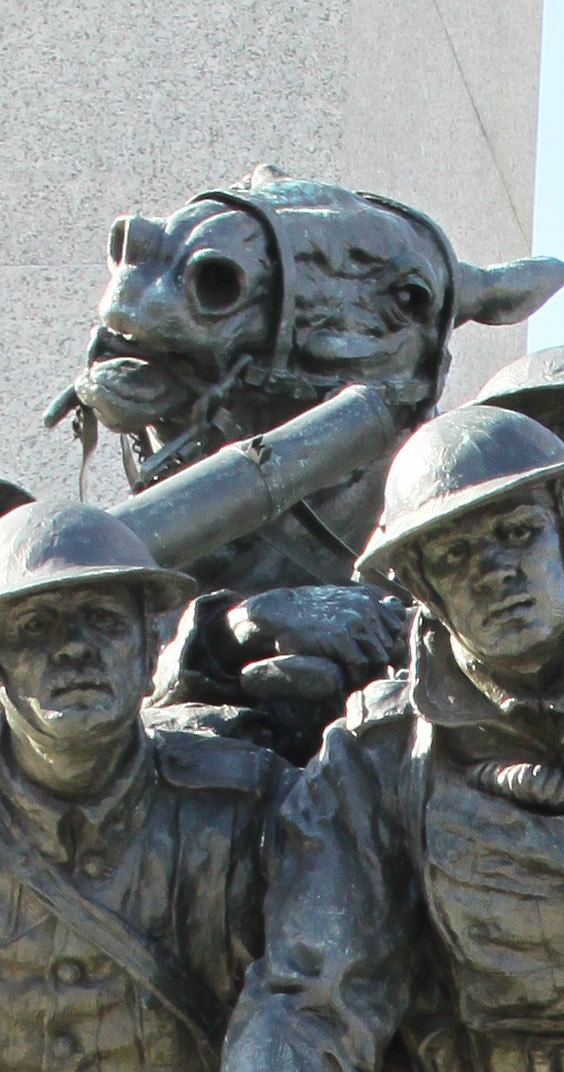
ottawa's war memorial

Ottawa's war memorial

I’ve spent less than a week in Canada, to my sadness.

After a day, the differences between here and the US were tangible. After nearly a week, the differences are overwhelming.

As a young English guy from Guildford told me at a bar in Toronto, Canada has all the advantages of the US (which for him were late licenses and plentiful weed) with none of the drawbacks. To drugs and alcohol I might also add: liveable human-scale cities, cosmopolitan cultures, a national respect for linguistic and ethnic diversity, a relaxed and positive sense of national identity, decent public transport, a progressive political system that publicly funds political parties and outlaws all corporate donations, a largely non-psychopathic government, great outdoors (although so far I’ve seen a lot of low-grade grassland (it’s not prairie – that was killed that long ago)), plenty of space and natural resources (a mixed blessing), good comedians (apparently) and surprisingly good beer.

In Ottawa and Toronto (although not Montreal) I saw a very low level of homelessness. In fact I saw almost nothing but healthy happy people, in good houses, with a very nice quality of life.

Frankly, its surprising any Americans still live in the US.

Did I mention, Canada also has universal health care?

Canada’s health care bill argument had some of the same elements of people crying “communist” as we’ve just seen in the US; but that debate was concluded 50 years ago, and unlike the US, not only did the best side win, but it achieved a genuinely-progressive result: single-payer healthcare, similar to Britain’s National Health Service.

Continue Reading »

Social Bookmark this: These icons link to social bookmarking sites where readers can share and discover new web pages.
  • Digg
  • del.icio.us
  • Facebook
  • Mixx
  • Google
  • Furl
  • kick.ie
  • Live
  • Ma.gnolia
  • NewsVine
  • Reddit
  • StumbleUpon
  • Technorati
  • TwitThis
  • YahooMyWeb
Email This Post Email This Post

books

22 Mar 2010

Two new books in the pipeline

Fresh from the intellectual stimulation this weekend of the Left Forum in Manhattan where I attended talks by the Reverend Jesse Jackson, Noam Chomsky, Arundhati Roy and Joel Kovel, I’ve decided to lay on the line that I’ve starting writing two books, one with Rupert Read, a philosophy reader at the University of East Anglia and a Green Party councillor in Norwich.

Eco-socialist Joel Kovel at the Left Forum

Eco-socialist Joel Kovel at the Left Forum

Mine and Rupert’s book – in which publishers have already expressed an interest – will be an extrapolation of what we have started on the Green Words Workshop and will include the latest research about how to popularise and “reframe” green political messages. The other book will be a solo self-published project probably to be called 50 Things Greens Do That Work, and has been inspired by my meeting greens from the US. It’ll be a compendium of best practice from both sides of the Atlantic: how to campaign, organise and succeed as a green (something that greens could always clearly use more of). And as I travel in the US I’m going to be asking greens what their best tips for success are. Watch this space!

Social Bookmark this: These icons link to social bookmarking sites where readers can share and discover new web pages.
  • Digg
  • del.icio.us
  • Facebook
  • Mixx
  • Google
  • Furl
  • kick.ie
  • Live
  • Ma.gnolia
  • NewsVine
  • Reddit
  • StumbleUpon
  • Technorati
  • TwitThis
  • YahooMyWeb
Email This Post Email This Post

America, Politics, racism

27 Feb 2010

American justice?

An American citizen, brought up and college-educated here in Brooklyn, is being held against his will, alone in a windowless room. He has been there for the last two years. He has not been convicted of any crime.

Before that, he was held in another windowless room for a year. He is not allowed to watch the news or to speak to anyone, except one family member at a time every few weeks, and even then only through the medium of a translator who will edit out anything he “should not” hear or say. His every move is watched by his captors on CCTV. He is allowed out of his cell for one hour a day, but not into the sunlight or fresh air: instead his jailers allow him to exercise inside a cage.

His case has attracted the interest and criticism of many American lawyers and groups such as Theatre Against the War, including such celebrities as Wallace Shawn.

He is charged with nothing more than allowing a duffel bag of waterproof socks and raincoats to be stored at his apartment in London. The only witness to this “crime” was a houseguest, who it turns out was in fact a government informer, and has a vested interest in testifying against him.

This American citizen is not being held by the Taliban, or by Al Qaida. He’s not being detained in Guantanamo Bay. He’s imprisoned in his own home town, in the centre of New York, by his own government; the American government.

Syed Fahad Hashmi is a young Muslim man in his twenties; a star of his class at Brooklyn College where he studied political science, and a masters graduate of international relations at the London Metropolitan University in England.

His teachers recall an eloquent and sincere man who would often act as a bridge and sympathetic negotiator between people with differing political views; a peacemaker and a diplomat.

But rather than furthering his career as a political scientist, it was Fahad’s fate to gain the distinction of being the first person to ever be extradited from Britain to the US under novel anti-terrorist legislation: it was in London’s notorious Belmarsh prison where he was first held for a year. Now imprisoned in New York, he is the subject of a community campaign led, not least, by his old college teachers, his parents, and his childhood friends & neighbours, to have him tried promptly and fairly, and for the US government to account for the treatment he has received.

His trial, which has been repeatedly postponed and now scheduled for the end of April, centres around the government informer who was Fahad’s house guest. This informer however is on trial separately himself, and will receive a reduced sentence for testifying against Fahad – one of the many causes of concern about the fairness of the prosecution’s case

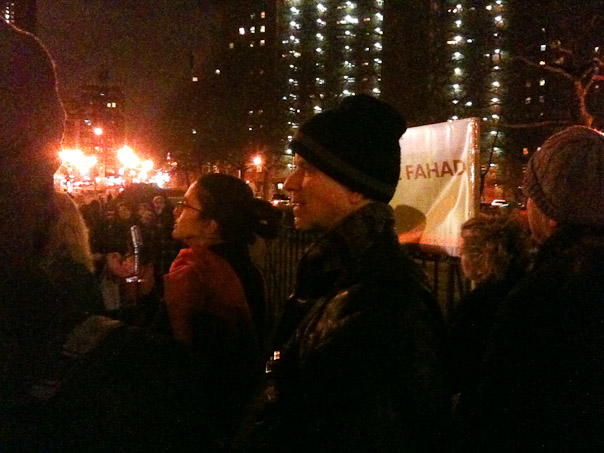
Last month I attended a vigil for Fahad outside the Metropolitan Correctional Center in Downtown Manhattan: about 150 people were in attendance, and the event, featuring an impromptu theatre performance about the history of sedition in America, was broadcast live on internet “Radio Free Fahad”.

Prof Jeanne Theoharis, Fahads old teacher, address the vigil

Prof Jeanne Theoharis, Fahads old teacher, address the vigil

I met his old school teacher, an impressive woman and knowledgeable powerful speaker. I watched his best friend from high school, a sensitive and tender young man, grieve over the torture his friend is going through. I can’t help feeling that if the most powerful nation on earth, and one that is ostensibly committed to the rule of law, freedom, justice, legal due process, democracy and human rights, can act like this towards its own citizens, then what hope does it have of setting an example of how a civilised nation should act?

www.freefahad.com

www.thawaction.org

The Facebook Group

Please help spread the word about Fahad Hashmi, and the way America and Britain have treated him.

Social Bookmark this: These icons link to social bookmarking sites where readers can share and discover new web pages.
  • Digg
  • del.icio.us
  • Facebook
  • Mixx
  • Google
  • Furl
  • kick.ie
  • Live
  • Ma.gnolia
  • NewsVine
  • Reddit
  • StumbleUpon
  • Technorati
  • TwitThis
  • YahooMyWeb
Email This Post Email This Post

America, Society

27 Feb 2010

Snow

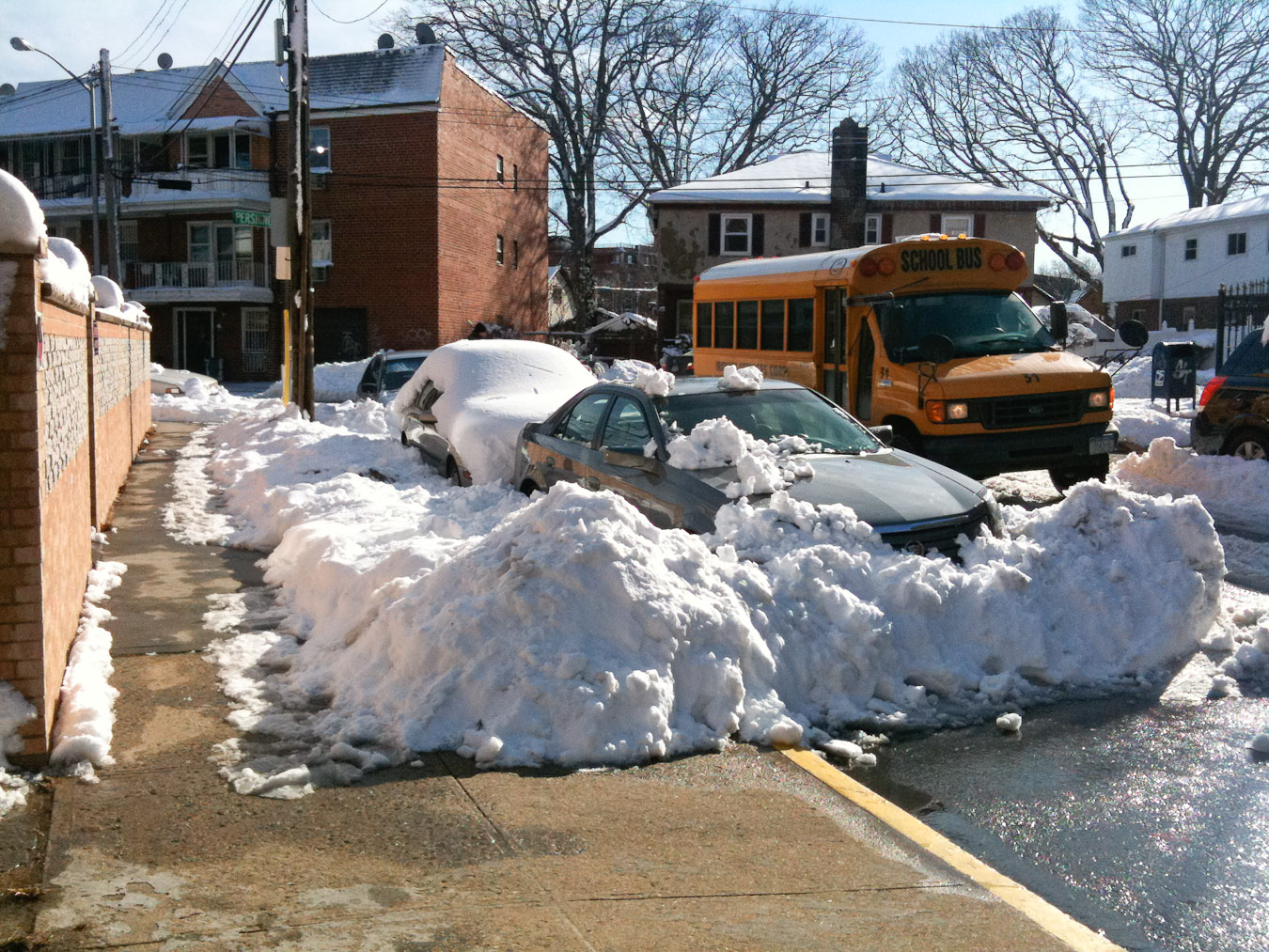
It’s snowing again. It’s falling softly tonight, in big gentle flakes. Everything in the yard has a little snowy hat on nearly two feet tall. The snow’s piled up in the streets. With the cold, cars were conking out in the road, and walking home last night it was impossible to tell where the pavement ended and the road began.

Something happens though when it snows that I’ve never really seen in Britain: instead of just leaving the snow in the street, householders come out of their homes and shovel it, making the sidewalk snow-free and much safer to walk on.

I told a New Yorker friend how I felt this seems a touching gesture of community spirit; she replied that’s what she had thought, for a long time. Needless to say I like the idea of people each playing their small part in achieving a larger communal goal of the common good.

And it’s impressive! It’s impressive to see that people have all got out and pitched-in and cleared the sidewalks. As my housemate commented, you want to say “Well done Bushwick, well done Ridgewood!”.

But in fact, and this is even more surprising to me (coming from Britain), New Yorkers are legally obliged to shovel snow that lands on the sidewalk outside their house (and I’m sure the shovel manufacturers love that!). This makes sense of course, but it just takes away some of the sentimental appeal…
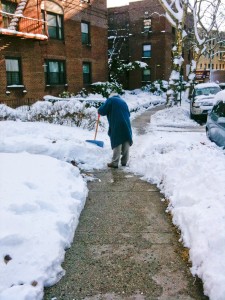
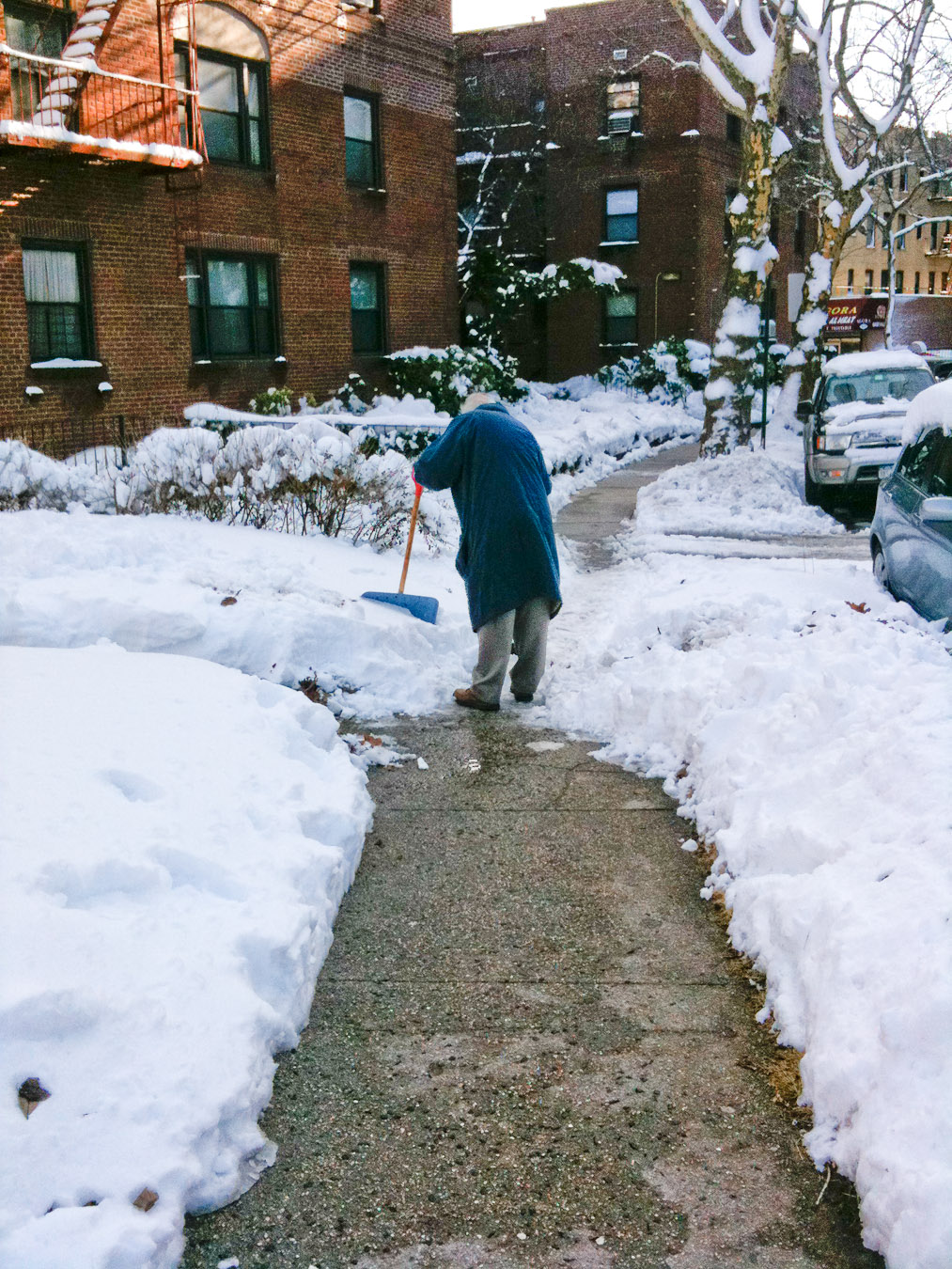
old man shovelling snow in residential Queens

Incredibly, according to the New York Times, they’re legally obliged to do this during daytime “within 4 hours” of the snowfall ending! Which would seem to put some pressure on people, especially older people. Equally I can’t imagine many students getting it together to get out of bed and shovel before the snow police come round! I saw one old man (pictured) who was obviously behind in his shovelling efforts. I stepped around him, saying hello. If I had known he was being legally obliged to shovel his sidewalk and wasn’t just doing it to be community-spirited, I would have taken the shovel off of him and asked him to put the kettle on while I did it myself.

America – and I dare say Americans – have a strange mix of impulses; in this case, the desire to be community-spirited, tied to a legal obligation to be so. It makes sense that mobilising the person-power of every householder to shovel snow makes sidewalks clear a lot quicker than any army of city workers that could be realistically mustered; so in this sense an “individualistic” solution works. But the way the individualistic effort is socially and communally enforced intrigued me. In a country where a large number of people strongly reject government obliging them to do things and insist on individual voluntary action instead, I wonder whether this city statute doesn’t in some ways manage to appeal to both an individualistic sensibility and a community one.

Individualists are unlikely to challenge it because what could be more obviously selfish and un-community-spirited than refusing to pull one’s own weight?

People more used to collective government action can hardly fault it either; it gets the job done. And neither they nor the individualists need worry about a burden on the tax-payer, because there isn’t one! Not to their wallet anyway (initial capital purchase of shovel aside….).

There are problems of course; not least the “equality” issue that the old man had; his ability to complete the task was not the same as other’s.

But could this be a template for collective action on other issues? Litter? Homelessness? Climate change??
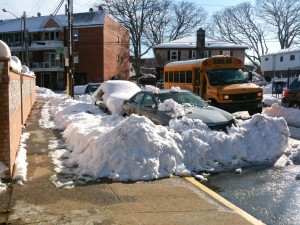
I find it amazing that the city has got away with people tolerating this prescriptive and burdensome ordinance, and presumably they do so because the problem is undeniable, pressing, universal, immediately obvious and tangible, and everyone has a degree of shared interest in its resolution.

Sadly the same cannot be said for homelessness and certainly not for climate change. Not because they are not important – but because people just don’t feel aware of them in the same way. Litter almost gets up there, but most people are clearly able to tolerate a lot of litter (certainly around here in Bushwick) before being provoked into individual action.

If only awareness of important pressing issues could be as obvious as the weather……. Oh, wait: it will be as obvious as the weather – literally – when climate change really bites. It will be the weather! And it will not only bring storms and floods and droughts and hurricanes to America but global economic infra-structural breakdown. But by then, of course, without a massive change in awareness, prevention will be too late.

Social Bookmark this: These icons link to social bookmarking sites where readers can share and discover new web pages.
  • Digg
  • del.icio.us
  • Facebook
  • Mixx
  • Google
  • Furl
  • kick.ie
  • Live
  • Ma.gnolia
  • NewsVine
  • Reddit
  • StumbleUpon
  • Technorati
  • TwitThis
  • YahooMyWeb
Email This Post Email This Post
Next »